
Why Healthcare Access Is Changing Faster Than Ever
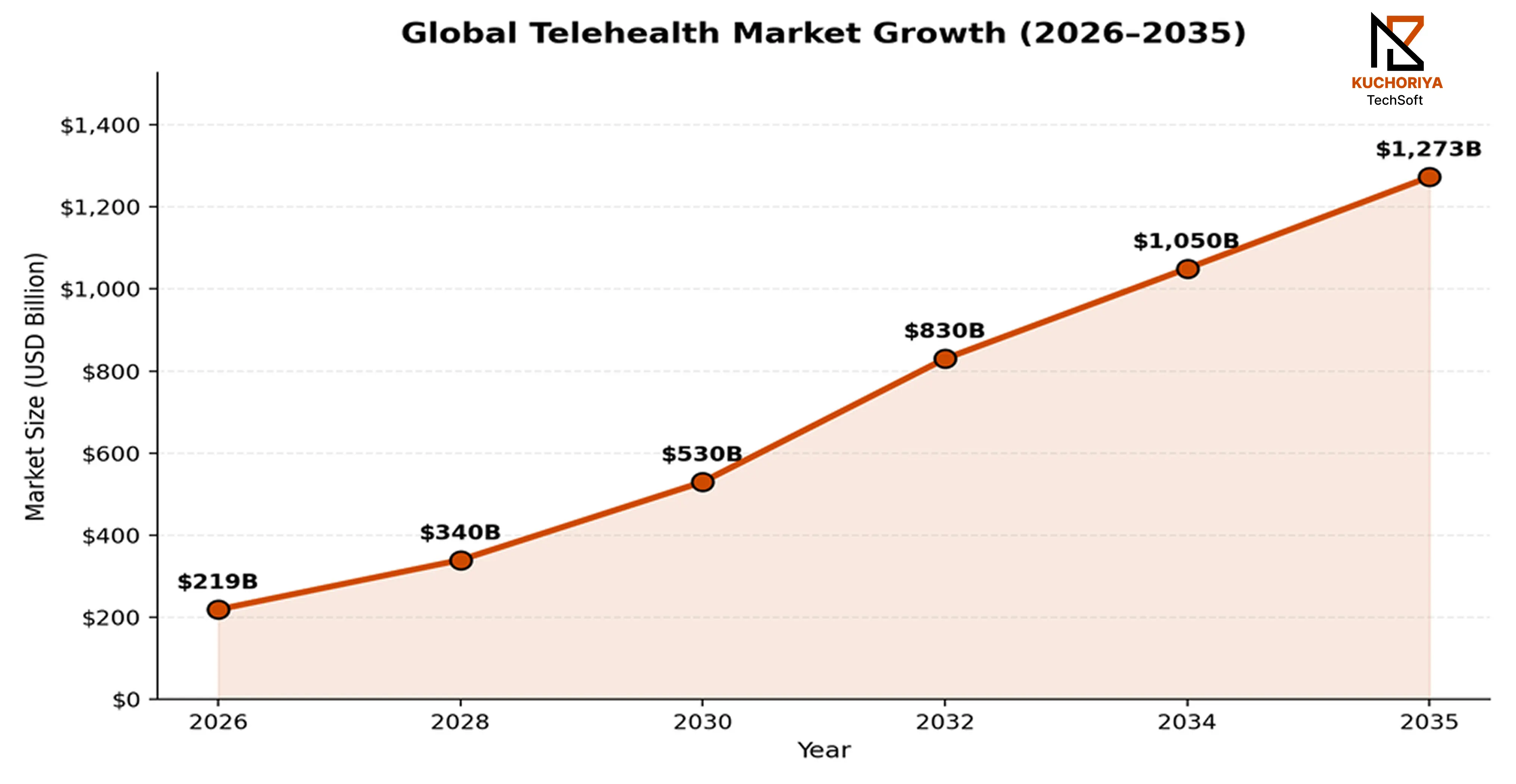
Patients used to book a clinic visit and wait days for a slot, even for something simple. That pattern is breaking fast, and demand for custom telemedicine app development keeps climbing as a result. The global telehealth market is set to grow from around 219 billion dollars in 2026 to over 1.4 trillion dollars by 2035, a pace few healthcare segments have ever matched.
Adoption backs this up too. Physician use of virtual visits jumped from roughly 14 percent in 2018 to 74 percent by 2022, and mental health alone now makes up close to 69 percent of all telehealth claims in the US, one of the biggest digital health trends right now.
This shift is exactly why professional healthcare app development has turned into one of the busiest corners of software right now, and why patients keep turning toward reliable digital healthcare solutions.
What Makes Doctor On Demand Different from Traditional Healthcare?
Driving to a clinic, sitting around, then getting a rushed few minutes with a doctor used to be the norm. A doctor on demand clone removes most of that hassle right away.
- Patients reach a doctor from wherever they already are, no travel involved
- A Virtual Healthcare Platform handles booking, records, and follow-up under one roof
- An Online Doctor Consultation App built this way keeps patients returning, unlike a bare video feature on its own
- Businesses often study a Doctor On Demand alternative closely before writing their own app spec
- Teams working on healthcare app development USA projects tend to use this exact model as their starting point
Why Are Businesses Investing in Apps Like Doctor On Demand?
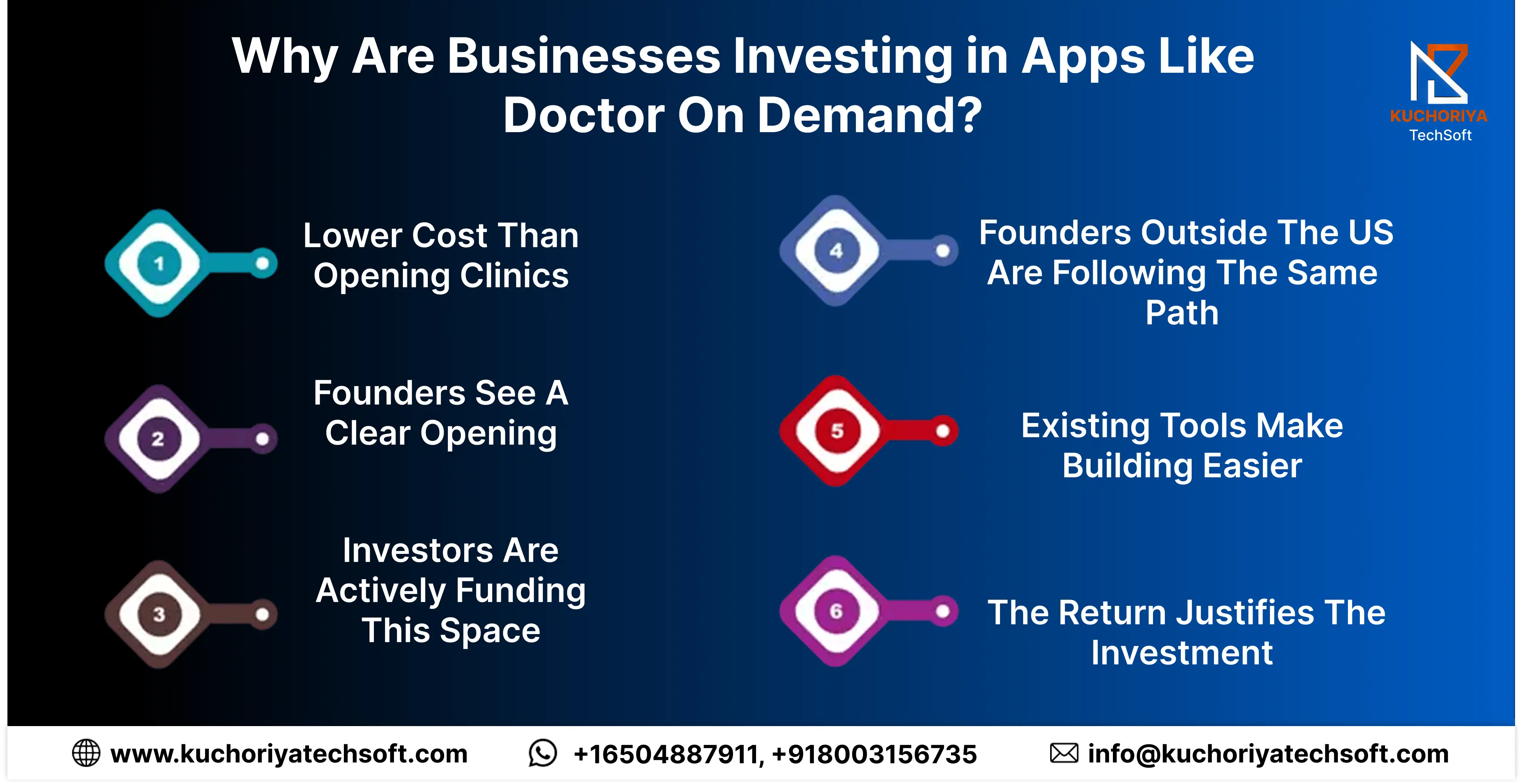
Healthcare startups aren't just adding an app anymore, they're building their entire care model around one. Here's what's actually pulling founders and investors toward this space right now.
1. Lower Cost Than Opening Clinics
Renting space, hiring front desk staff, and running physical locations adds up fast. A telehealth app development project lets a startup reach the same number of patients without any of that overhead.
2. Founders See A Clear Opening
A lot of the current wave of healthcare startup app ideas center on niche care, therapy, dermatology, chronic condition management, areas traditional clinics still handle poorly.
3. Investors Are Actively Funding This Space
Recent healthcare startup funding trends show digital health pulling in billions each year, with AI-focused platforms taking the largest share of that money.
4. Founders Outside The US Are Following The Same Path
The pattern isn't limited to one region. Digital health startup ideas are showing up across UK founders too, many exploring telemedicine app development UK projects to serve local patients without regional licensing headaches.
5. Existing Tools Make Building Easier
A founder doesn't need to build every piece from scratch anymore. Various healthtech startup solutions already cover video infrastructure, payments, and compliance, cutting months off a typical build timeline.
6. The Return Justifies The Investment
The real benefits of telemedicine apps for startups show up in retention. Patients who use a platform once tend to come back for follow-ups instead of switching to a competitor.
Must Read: How to Build a Telemedicine App Like Teladoc Health: Features, Cost & Development Guide
How Much Does It Cost to Develop a Doctor On-Demand App Like Practo & Teladoc?
What Features Define a Successful Telemedicine App?
A video call button alone doesn't keep patients coming back. A few small details end up deciding whether someone books a second time.
1. Fast Booking Flow
Patients want to check the availability of real doctors the moment they open the app. A solid doctor appointment app shows that a callback forces one to wait until the next instance, and the maximum checkout disappears as soon as it is actually scheduled.
2. Stable Video Calls
Bandwidth dips happen constantly on mobile networks. Video consultation app development done right lowers video quality automatically instead of letting the call drop, and patients rarely complain about a blurry picture the way they complain about a dead call.
3. Instant Pharmacy Routing
A doctor finishes the consult, signs off, and that's usually where the paperwork used to start. With e-prescription app development, the order goes to the patient's pharmacy in that same moment, no slip, no separate trip.
4. Unified Patient Records
Doctors hate to repeat questions that a patient has already answered elsewhere. The patient management software continues the prescription under a record with each trip, so the accompanying physician already knows the records before the decision offevolved even begins.
5. Smart Appointment Reminders
Missed slots cost doctors real time. An appointment scheduling app for doctors sends reminders on a set schedule and lets patients reschedule with one tap, cutting down how often a doctor sits waiting on an empty call.
6. Easy Prescription Refills
Not every medication needs a full consultation to renew. A built-in online prescription app feature handles routine refills through a short doctor review, so patients skip booking a whole appointment for something this simple.
How Does AI Improve Apps Like Doctor On Demand?
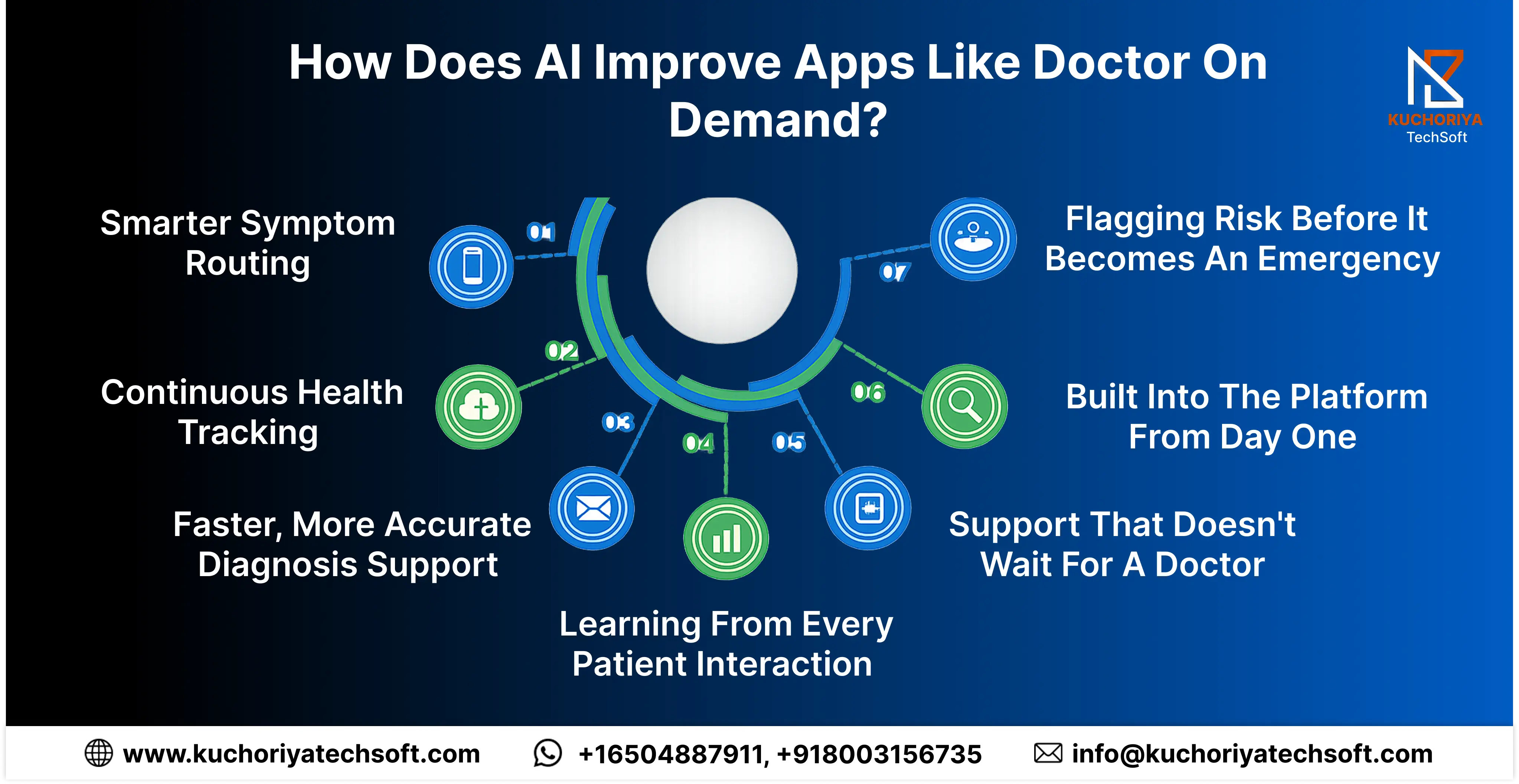
AI stopped being a bonus feature in telemedicine a while back. It now shapes how fast a patient reaches the right doctor and how early a problem gets caught.
1. Smarter Symptom Routing
Typing symptoms into a form only tells half the story. An AI telemedicine app reads that input alongside patient history, and a working AI symptom checker app on top of it sends people to the right doctor without the usual back and forth of getting redirected.
2. Continuous Health Tracking
Vitals shift between visits far more than a single monthly checkup ever shows. That's the gap AI in remote patient monitoring closes, watching numbers daily and alerting a doctor the moment something drifts, long before the next appointment rolls around.
3. Faster, More Accurate Diagnosis Support
Nobody's replacing a doctor's judgment here. What AI in medical diagnosis actually does is scan through thousands of past cases in seconds, giving doctors a comparison point no single person could pull together from memory alone.
4. Learning From Every Patient Interaction
A fixed rulebook doesn't improve on its own. A machine learning in healthcare app setup gets sharper with every patient interaction, adjusting recommendations based on real outcomes instead of static logic written once and never touched again.
5. Support That Doesn't Wait For A Doctor
Most pre-visit questions never actually need a doctor to answer them. An AI chatbot in a healthcare setup takes those off the queue entirely, leaving doctor time free for patients whose cases genuinely require one.
6. Built Into The Platform From Day One
Adding AI as an afterthought rarely holds up under real use. Teams that treat AI in healthcare app development as core architecture end up with an AI-powered healthcare app that keeps performing even as patient numbers climb, backed by solid AI healthcare solutions underneath.
7. Flagging Risk Before It Becomes An Emergency
Every patient waiting their turn equally sounds fair until someone's condition can't wait. Predictive analytics in healthcare app tools move urgent cases ahead automatically, and this is where most AI in healthcare, and AI in healthcare industry growth is actually headed, inside what people now call an AI-driven healthcare platform.
What Technology Powers a Telemedicine Platform?
A clean interface up front only works if the systems behind it actually hold together. Here's the tech stack that keeps a real telemedicine platform running.
- Core Telemedicine Software ties booking, video, and records into one working system instead of separate disconnected tools
- Medical video consultation software handles the actual call, built to stay stable even when a patient's connection isn't great
- EHR integration app support connects the platform to hospital record systems, so nothing gets typed in twice
- An electronic health records app layer keeps every prescription and visit note attached to the right patient permanently
- mHealth app development covers the mobile side specifically, since most patients book and consult straight from their phone
- Wearable health app integration pulls in data from fitness trackers and monitors, feeding real vitals into the consult
- Healthcare CRM software manages patient communication and follow-ups without a separate system running on the side
- A cloud-based healthcare app setup scales automatically as patient numbers grow, no server upgrades needed mid-launch
- Virtual clinic app development structures the whole platform around departments, similar to how a physical clinic is organized
- Telepsychiatry app development adds the specific privacy and session structure that mental health consults need
- Telehealth software for clinics helps smaller practices go digital without rebuilding their entire operation from scratch
- Solid Healthcare mobile app development work keeps the app fast and stable regardless of device or OS version
- eHealth app development as a broader practice ties all these pieces together under one long-term maintenance plan
- A built-in chatbot for healthcare app feature handles quick questions before they ever reach a doctor's queue
- Remote patient monitoring app tools close the loop, tracking patient health even after the appointment officially ends
What Does It Cost to Create an App Like Doctor On Demand?
Ask five agencies this and you'll get five different numbers, mostly because nobody's building the exact same thing. Here's a rough breakdown based on what actually goes into each version.
A quick telemedicine app development cost check usually starts here, though your actual number moves based on which features make the final list. If someone quotes a flat cost to build a telehealth app figure without asking what you need first, that number probably won't hold once development starts.
We'd rather scope things properly through custom telehealth app development services, looking at your target patients, compliance region, and which features actually matter to your launch before quoting anything.
What Compliance and Security Standards Should You Follow?
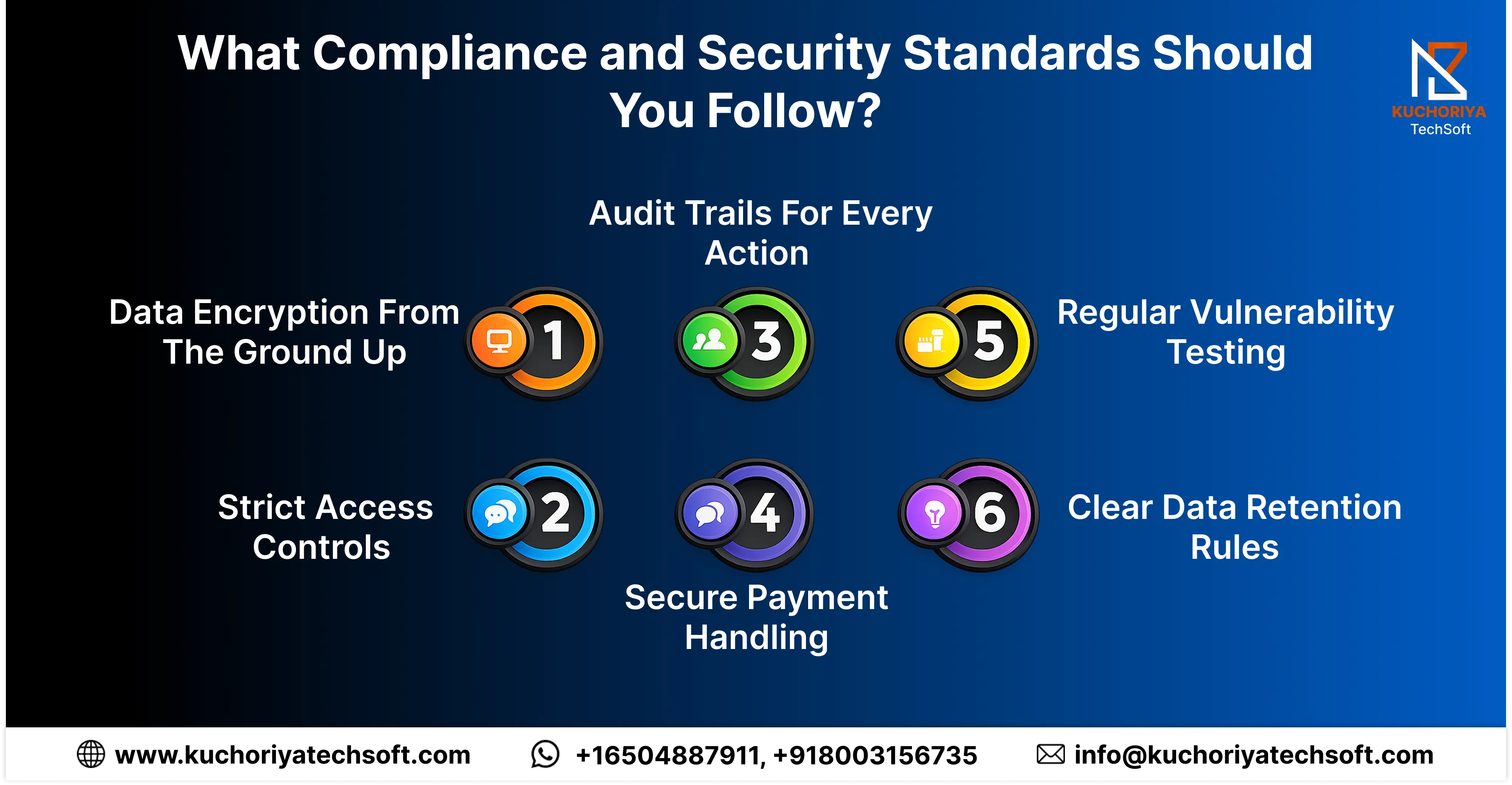
A data breach in healthcare doesn't get fixed with an apology email. Getting these standards right from day one is what actually protects a platform long term.
1. Data Encryption From The Ground Up
Nothing about a video call or a stored file should sit unprotected, not for a second. A HIPAA-compliant telemedicine app locks that down from the first sprint, long before a single patient ever logs in.
2. Strict Access Controls
A nurse doesn't need admin-level access, and an admin doesn't need to see every clinical note. Splitting access by role this way keeps sensitive information away from anyone who doesn't actually need it.
3. Audit Trails For Every Action
Someone opens a file, edits a note, shares a record, all of it needs a trace. Proper HIPAA-compliant healthcare app development logs each of these automatically, so a compliance review never turns into a guessing game.
4. Secure Payment Handling
Billing data behaves nothing like a medical record, and treating them the same is where a lot of platforms slip up. Keep payment information walled off on its own, so a weak spot there never touches the rest of a patient's health data.
5. Regular Vulnerability Testing
A checklist from six months ago tells you nothing about today's risks. Secure healthcare app development means someone's actually running penetration tests on a schedule, finding the gaps before an outsider does.
6. Clear Data Retention Rules
Patients' old records shouldn't just pile up forever with nobody deciding what happens to them. Set a real timeline for how long data stays, and what gets deleted once it's served its purpose.
Related Reads: AI in Healthcare Cost Guide 2026: Pricing, Development, Implementation & ROI Explained
Top 10 AI Development Companies in the USA for HIPAA-Compliant Healthcare Solutions
Custom EHR & EMR Software Development Services: Complete 2026 Guide for Healthcare Providers
How Do Telemedicine Apps Generate Revenue?
Nobody's betting the whole business on one revenue stream anymore, not in this space. Most platforms end up stacking a few different ones together.
- Per-consult fees are usually where a telehealth business model starts, charging patients directly each time they book a doctor
- Subscriptions bring in steadier income from patients who consult regularly instead of paying one-off each visit
- A chunk of telemedicine app monetization comes through partner commissions, taking a small cut when a pharmacy or lab gets business off a referral
- Some platforms also sign enterprise deals, where a company pays to offer the app as part of an employee health package
- A few Virtual care solutions even monetize through anonymized data insights, selling patient pattern trends to health systems without touching individual privacy
Why Choose Kuchoriya TechSoft for Telemedicine App Development?
Plenty of agencies can write code. Fewer have actually shipped a platform patients trust enough to keep using after the first visit.
1. Real Experience, Not A First Attempt
Our team runs full telemedicine app development company work end to end, having already delivered builds patterned after names like the Teladoc clone app, Amwell clone development, and MDLive-like app projects.
2. A Team You Can Actually Scale With
Need one specialist or a full build crew? You can hire telemedicine app developers for a specific feature, or hire healthcare app development company support for the entire project from day one.
3. Recognized Where It Matters
Clients looking for the best healthcare app development company usually land on the same shortlist, and we've stayed among the top healthcare app development companies on that list through repeat client work, not one lucky project.
4. Built On A Model That Already Works
Rather than reinventing the wheel, our approach to on-demand doctor app development borrows from what already succeeds, adapting a telehealth platform like Doctor On Demand to your specific patient base.
5. Handling Both Ends Of The Platform
Whether it's patient-facing features or backend infrastructure, our on-demand healthcare app development covers both sides, so nothing gets outsourced separately or left half finished.
6. Retention Built In, Not Bolted On
Getting a patient to book once is easy. Our patient engagement app development work focuses on the harder part, getting them to come back for the next visit too.
7. Staying Ahead Of Where This Is Heading
We track healthcare app development trends in 2026 closely, so your platform launches with the features patients expect now, not the ones that mattered two years ago, backed by a team recognized as a best on-demand app development company.
Building Your Doctor On Demand Clone Starts Here
A good idea only goes as far as the team building it. This is where that idea actually turns into something patients can open and use.
We've delivered healthcare app development USA projects for solo clinics and multi-state networks alike, handled a telemedicine app development UK build with its own regulatory quirks, and shipped a healthcare app development company Dubai platform designed around regional patient habits. Our work has also covered a telehealth app development UAE project needing strict data residency, a healthcare app development Canada rollout across multiple provinces, a telemedicine app development Australia build for a growing telehealth network, and a healthcare app development Singapore platform serving a regional hospital group.
Wherever your patients are, we've likely already solved a version of the problem you're facing right now. If you're an agency or consultant looking to bring us in on client projects, our Referral Partner Program is worth a conversation too.
Contact us today to talk through your Doctor On Demand clone, no matter where your patients are based.
Common Questions About Building A Doctor On Demand Clone
Q. What actually separates the best on-demand doctor app from one that just looks similar?
A. Speed to a real doctor and a call that doesn't drop halfway through; that's usually the whole difference. Patients don't care about a feature list if the basics fall apart mid-visit.
Q. How would I even judge if my app stacks up against the best telemedicine app names out there?
A. Watch whether patients book a second visit, not how many downloads the app gets. A repeat booking says more than any install number ever will.
Q. What's likely to define the best telehealth app 2026 brings versus what worked a couple years back?
A. AI-based triage, tighter EHR syncing, and calls that hold up on a weak signal. Apps still missing these are already losing ground to newer competitors.
Q. What do most of the top telemedicine apps get right that smaller ones usually miss?
A. Real-time doctor availability and prescriptions that route on their own without manual steps. Past that, it mostly comes down to how smooth the whole flow feels.
Q. Who's actually leading among the top AI in healthcare companies right now?
A. The names shift often, but they're mostly building symptom triage and diagnosis tools that other healthcare startups plug straight into their own apps.
Q. What should I actually check before trusting one of the best AI healthcare companies with my project?
A. Ask if they've shipped something live already, not just a demo. A working deployment tells you far more than any pitch ever could.